


How financial inequality is impacting the football pyramid
- Luke Jones

- May 2, 2023
- 5 min read
Updated: May 3, 2023

Financial inequality has long plagued the football pyramid. Many clubs find themselves with wealthy owners who can invest in the club and, most importantly, ensure its survival. However, not every club is as lucky, with many in the lower tiers often finding themselves struggling to pay wages never mind investing in the club to take it to the league above. Financial inequality has many effects on the football pyramid, with the most notable being that it affects the competition and integrity of the leagues.
Which clubs have found success under new ownership?
In recent years we have seen a large influx of foreign and wealthy owners coming to the United Kingdom to invest in what they think will be the next big team. In the Premier League, we have seen investment into the likes of Chelsea and Manchester City which took them from the bottom of the top division to fighting for the most prestigious of European honours.
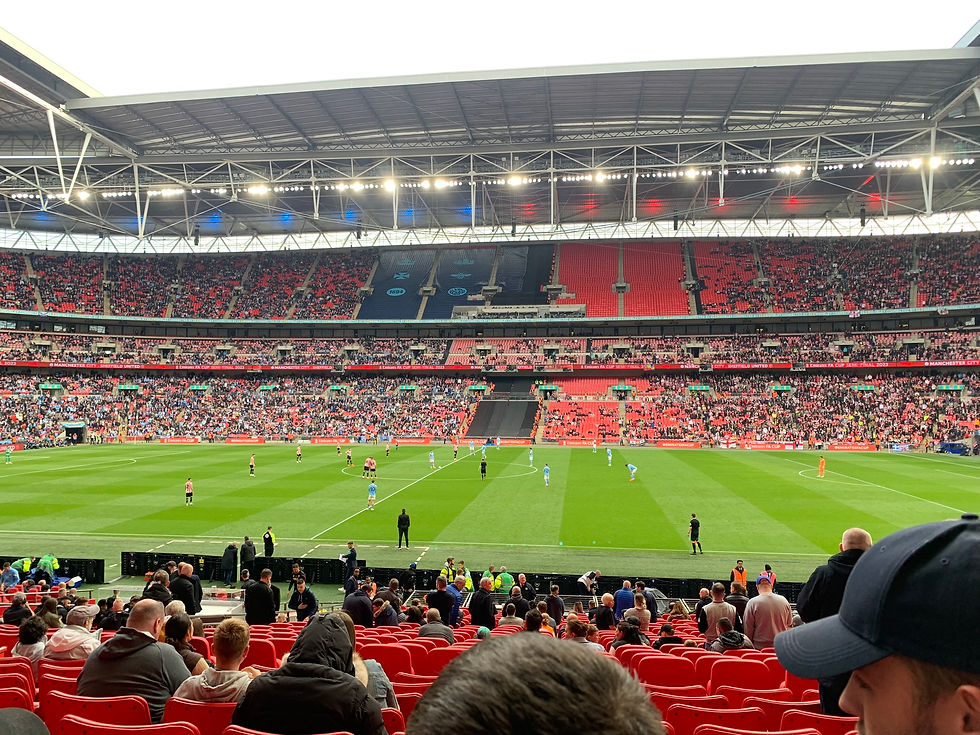
In lower divisions, we have also seen owners who, maybe not as wealthy as the Sheiks and the consortiums of the world, share the same ambition to take their club to the very top of the English pyramid. Over the past just 10 years we have seen large investments come into the likes of Wycombe Wanders, Portsmouth, Wigan and Salford City in the hopes of bringing their sides to the top level of the English game. Most recently and most notably though, the Hollywood takeover of Wrexham AFC has saw them complete a record-breaking season to get out of the National League for the first time in 15 years having spent £3 million, which is more than the rest of the division, bar Notts County, combined.

How do teams compete with financial inequality?
At a time when clubs lower down are struggling more than ever to compete with other, wealthier, clubs it is important to understand how smaller clubs deal with these issues to ensure they remain as competitive and financially effective as possible
To get a better understanding of the issues I headed to National League outfit Barnet FC to talk to the Head of Media and Communication, and the man who helped push through Chelsea’s sale to Todd Boehly, Dominic Rosso. I also spoke to Press Officer Lewis Hawkins, a man who is frequently in touch with the club chairman and is well-informed on the current state of affairs at the club.
We discussed how they feel financial inequality can be dealt with by both clubs and regulators, what Barnet are doing to ensure they remain as competitive as possible as well as their thoughts on how financial inequality and lack of regulation caused unfortunate outcomes for the likes of Bury and Macclesfield Town.
Does financial inequality ruin the competitiveness of the National League?
I spoke to Dom Rosso first to ask for his verdict on financial inequality and whether it ruins the competitiveness of the National League.

Rosso says that this season the National League has had “2 very clear frontrunners” and there is a “very clear imbalance between those 2 and the rest of the division”.
Rosso says, “I wouldn’t necessarily say it creates an imbalance as football is a sport in which the top-placed team can very easily be challenged by the bottom-placed teams. Although, whilst on paper it has created an imbalance between the top 2, especially one in particular [Wrexham], and the rest of the field I feel that on the day anything can happen in the 90 minutes”.
I asked Lewis Hawkins the same question, to which he offered a similar but also different response. Hawkins says “There is a clear divide between the top teams, obviously you have got a lot of teams coming from the football league like Notts County, Dagenham who are full-time teams compared to at the bottom of the national league where not everyone is actually a full-time club. We’ve had part-time teams like Weymouth come up but go straight back down as they simply cannot compete with the level and finances of the National League proper.”
How do Barnet deal with investment into other clubs?
Once I had a good understanding on what they both thought respectively about the finances of the National League, I wanted to delve deeper into how Barnet deal with investment into other clubs as they proceed to work on a significantly smaller budget.
As someone who has a vast understanding of the finances of football and, in particular Barnet FC, I spoke to Dominic Rosso about how Dean Brennan’s side has managed to secure a playoff place despite not having the largest budget in the division.
Rosso said “it’s on the record that Dean [Brennan] has been given a good budget but the budget does not even compare to the other clubs in this division. I think that the club deals with it by focusing on personnel, having the right people in the dressing room and right management actually counts as 9-tenths of the law. We’ve seen clubs, not just in the National League but actually at the very top of the English game invest millions and millions but actually, if the personnel is not right and the balance is off they can quite easily see themselves down in 9th or 10th.

“I think clubs, not just in Barnet but right across the country, really need to focus on having the right personnel and having the right structure in place as that is a key to success”
How do you feel about clubs being able to spend millions while others go under, seemingly without receiving any support?
After gaining a good understanding of how the finances of the National League work as well as how teams like Barnet are still able to compete despite not having the largest of budgets, I wanted to see what they thought about clubs failing to survive while others spend millions if not billions of transfer fees and stadium developments.
As a man who knows a lot about football finances and regulation, Rosso was the first to talk to me about clubs failing to survive due to the lack of support from governing bodies and other football clubs.
Rosso said “I think we can all agree that what happened to the likes of Bury and Macclesfield is tragic – that’s hundreds of years of history just gone down the pan. What happened is unacceptable and what I would say is that there needs to be better regulation, there needs to be a fit and proper owners test, there needs to be better protection and this starts right at the top with the Government.
“We saw last year in the white paper that they were working on protecting these clubs, but it needs to be done soon to now allow them to go out of business. These are not just football clubs, these aren’t just people on a field. These are community hubs, these are institutions which have existed for hundreds of years.
Rosso finished his point by saying “While you have the fantastic money and infrastructure right at the top, the people at the bottom are given no protection and I think that’s something which really needs to be implemented very soon”.
Following my time at Barnet I came away with a few key points, those being that clubs at the bottom need to be offered far more protection by the government and that in terms of competition, money isn't always the key to a club's success.


Comments